EN DE
Watch Shandong International Trust for free: we tell you when fair value or trend changes.
Data-driven stock valuation

Shandong International Trust (1697) fair value: what the stock is really worth

As of Nov 13, 2026: fair value (intrinsic value) of Shandong International Trust stock HK$0.42, price HK$0.22, upside +97.2%, quality 52 out of 100. Rating: strongly undervalued. Calculated from audited financials with 2 of our 26 valuation models and 37 quality factors, updated daily.

  1. Keep an eye on it?Free in your watchlist: 5 stocks without an account, 10 with one Yes, for free

Financial Services HK · Home China · ISIN CNE100002R24

SI Shandong International Trust logo Thin data Nov 11, 2026

Shandong International Trust

1697 · HK

Cheap (49% below fair value) and solid company, but falling price: meets 2 of 3 rules.

Get notified free when this changes
Fair value HK$0.4240 · Strongly undervalued 
Even on cautious assumptions the value is 48% above the price (HK$0.3180). 
Quality 52/100 
Mixed Growth (revenue 5y +3.2 %/yr in CNY) 
Thin margins · 8.3% net margin (FY2025) 
Falling price (downtrend) 
Negative free cash flow 
Trails peers (3/9) 
Narrow moat 41/100 · thin data
Thin data 
Watch Shandong International Trust for free: we tell you when fair value or trend changes. Watch for free

What runs behind every stock

69 individual criteria per stock, every one traceable See the method →

Price vs Fair Value

HK$0.6700 HK$0.2100 Fair Value HK$0.4240 Jul 2021 Nov 2026

White line = price, green steps = our fair value per fiscal year. As of Nov 11, 2026.

How to read this chart

60‑month range HK$0.2100 – HK$0.6700 · fair‑value band HK$0.3180 – HK$0.5300 · the HK$0.2150 price screens below the HK$0.4240 fair value. Green steps = our fair value per fiscal year (point-in-time, no hindsight). As of Nov 11, 2026.

Follow Shandong International Trust in your weekly email

Every Wednesday you see whether Shandong International Trust is on track or worth a review, plus price against fair value. Free, up to 3 stocks.

We send you a confirmation link. Unsubscribe with one click.

Which stocks are undervalued right now? Check free Discover now →

Company profile

Shandong International Trust Co., Ltd., a non-bank financial institution, provides various trust services in the People's Republic of China. It operates through Trust Business and Proprietary Business segments.

Show moreShow less

The company offers private equity investment banking services to various enterprises and institutions and asset and wealth management services to institutional investors and high-net-worth individuals.

It also provides administrative services to the trustors through administrative management trusts, as well as wealth planning, intergenerational inheritance, custody, bankruptcy isolation, and risk disposal services.

In addition, the company invests its assets in various types of equity products, such as listed stocks and mutual funds, as well as wealth management products. Shandong International Trust Co., Ltd. was incorporated in 1987 and is headquartered in Jinan, the People's Republic of China.

Stock analysis

Shandong International Trust (1697) currently trades at HK$0.2150, while our model-based Fair Value estimate is HK$0.4240, implying the stock looks roughly 49% undervalued today.

Show more

Valuation

How firm this estimate is: it rests on 2 models at a data quality of 96/100, which puts the data coverage at low.

Scenario range: HK$0.3180 (bear) to HK$0.5300 (bull), the price of HK$0.2150 sits below it. Bear and bull are the same models on cautious and optimistic assumptions, a range, not a price target.

Quality & growth

The Quality Score stands at 52/100 (solid quality), in the Financial Services sector.

Mixed Growth: Spin-off in 2020: revenue and profit before it include the divested business. Growth is measured afresh from 2020.

Shandong International Trust reported revenue of 650M CNY in FY2025 versus 568M CNY in FY2021, a compound +3.4%/yr. Reported net income was 53.7M CNY in FY2025, compounding −41.8%/yr from FY2021.

Key figures

Market cap HK$1.0B (≈ $128M) Micro · P/E ratio 28.0 · P/S ratio 2.31 · Dividend yield 5.5% · Net margin 8.3% · Return on equity −2.1% · Return on assets (EBIT) 2.3% (5-year average) · Operating margin 187%.

Competitive moat

Our AI-assisted moat analysis scores the competitive advantage at 41 out of 100 (low confidence).

What moves the price

The share trades about 46% below its 52-week high and 2% above its 52-week low, currently below its 200-day average.

For context, the median of 10 Financial Services peers we cover trades at −25% fair-value upside, at 97%, 1697 screens cheaper than that median.

Fair Value models

Bear HK$0.3180 Fair Value HK$0.4240 Bull HK$0.5300
Price HK$0.2150 · Upside +97.2%
Capped: our models arrive at a very high value here. We deliberately show a more cautious Fair Value.
Model ⓘEach model values the company its own way (discounted cash flow, earnings, assets, dividends). The fair value above starts from their evidence-weighted blend, not from a single model. In cyclical trough or peak years, after dilution or a stock split it is adjusted afterwards, so it can sit above or below the models. Bear ⓘBear = the cautious scenario: the same model computed with conservative anchors (lower growth, margins and valuation multiples). Together with Bull it frames a plausible valuation range, not a price target.BaseBull ⓘBull = the optimistic scenario: the same model computed with favourable anchors (higher growth, margins and valuation multiples). Together with Bear it frames a plausible valuation range, not a price target. If a model's bull case is above four times its base value, the table shows that limit with a > sign (like the overall Bull above): beyond it no assumption holds. Coverage ⓘCoverage = how well-backed THIS model's estimate is for this stock (0–100): how complete and reliable its input data are, and how well the model fits the company. The final Fair Value is an evidence-weighted blend, so better-evidenced models count more. Green ≥70, amber 50–69, grey below 50.
Best data coverage
P/B Multiple HK$1.81 HK$2.41 HK$3.01 55
NCAV (Graham) HK$1.41 HK$1.89 HK$2.82 51
All 2 models by family
Multiples
P/B Multiple HK$1.81 HK$2.41 HK$3.01 55
Asset-Based
NCAV (Graham) HK$1.41 HK$1.89 HK$2.82 51

Open the full fair value analysis →

Quality Score breakdown

Overall quality 52/100

It rates the business: profits, how they develop, real cash, balance sheet, investing and share count.

Profitability 17
How much profit the company makes from its sales and capital
Quality Growth 60
Are margins and returns getting better?
Cashflow 0
Do the profits arrive as real cash?
Financial strength 63
Debt, balance sheet and risk of trouble
Investment 96
Does it invest with discipline instead of growing at any price?
Low Volatility 76
How calm the share price moves, does not count
Price momentum 13
Price momentum of the last 3 to 12 months, does not count
Near the 52-week high 1
Distance to the 52-week high, does not count
New shares 82
Buys back shares or issues new ones?

Open the full quality analysis →

Revenue & earnings trend

Growth Quality ⓘGrowth is valuable only when reinvestment earns attractive returns (Aswath Damodaran): sustainable growth depends on return on capital, reinvestment and efficiency. Basis: total company revenue over the periods shown on the cards (3Y/5Y/all years), not per share, so a merger can show up as a growth jump; per-share earnings growth is in the value-creation card. 55/100
Spin-off in 2020: revenue and profit before it include the divested business. Growth is measured afresh from 2020.
Revenue growth 1 year
+27.3%
Revenue growth 3 years ⓘMeasures the company's TOTAL revenue from reported annual statements: compound average growth per year (CAGR) from the fiscal year 3, 5 or N years back to the most recent comparable fiscal year. Not per share: buybacks do not change this number, and a merger can appear as a growth jump. Per-share growth (which does include buybacks) is in the value-creation card.
−8.6%
Revenue growth 5 years ⓘMeasures the company's TOTAL revenue from reported annual statements: compound average growth per year (CAGR) from the fiscal year 3, 5 or N years back to the most recent comparable fiscal year. Not per share: buybacks do not change this number, and a merger can appear as a growth jump. Per-share growth (which does include buybacks) is in the value-creation card.
+3.2%
Start year 2020 (pandemic)
What shareholders gained per year (last 5 years) ⓘWhat the business itself delivers per year: earnings growth per share plus the dividend yield. This is what you get IF the market keeps valuing the stock the same way: it contains no assumption about the market changing its mind. Computed per share, so buybacks count and a merger does not pass as growth. For a company that pays no dividend it is pure earnings growth per share. Period: earnings growth per share as CAGR over the last 5 reported fiscal years (annual statements), plus the current dividend yield. The start value is the median of the three years around the start, so a single crisis year (a pandemic or a write-down) does not distort the rate. Basis: EBIT basis.
−10.6%
Earnings growth per share plus dividend.
Earnings per share, growth per year−16.1%
Dividend (yield on the price)5.5%
Pace: 5 vs 10 years ⓘTwo data points, not a trend model: earnings growth per share over the last 5 fiscal years against the last 10. Labelled "steady" when both rates are within 3 percentage points of each other, otherwise picking up or flattening. Shown only when ten years of history exist.−38.8% vs −25.2%, slowing
Profit margin 2020 to 2024 ⓘOperating margin then vs now, from reported annual statements. A falling margin after a boom year is the classic peak-earnings signal: the growth rate then leans on an inflated base.66% → 58%
Pace: the 5-year rate starts in 2020 (pandemic)
⚠ Revenue per share shrinking 9.0%/yr over ~10Y (margins eroding too) ⓘStructural-decline marker: revenue PER SHARE has fallen over the last decade (robust median trend, not a single year). Backtested across 2005 to 2017, such businesses trailed the market by about 2.5 percentage points per year. Display only: it does not change the fair value or the quality score.

Watch 1697, get fair value alerts →

Compare Shandong International Trust with another stock

Price, fair value, quality and upside side by side.

Free, no sign-up

Peer GroupⓘHow this stock ranks against its industry: the green marker is this stock, the band is the typical 25–75% peer range, and the tick is the median.Asset Management · 634 stocks

Beats the industry median on 3/8 measures
Overall it trails its industry peers.
Valuation
Quality Score 52 · Below median
Fair Value upside +97.2% · Top 25%
Profitability
Return on assets 0.4% · Below median
Net margin (12 months) 8.3% · Below median
Operating margin (12 months) 186.8% · Top 25%
Growth and dividend
Revenue growth (quarter YoY) −79.5% · Bottom 25%
Dividend yield (12 months) 5.5% · Above median

Valuation Multiplesvs Asset Management median · lower = cheaper

P/E (12 months) 28.0× · Priciest 25%

Strength profile in five axes (Snowflake)

VALUEFUTUREPASTHEALTHDIVIDEND
This stock
VALUEFUTUREPASTHEALTHDIVIDEND
Sector peers
VALUE (fair-value potential)100 · sector 37
FUTURE (revenue growth)0 · sector 36
PAST (return on equity)0 · sector 21
HEALTH (low debt)0 · sector 96
DIVIDEND (yield)100 · sector 75

Context: sector, industry, market

Values & ESG

Does this company touch areas you may want to avoid? The classification is inferred from sector and industry.

None of the checked exposures detected

Similar stocks

10 more Asset Management stocks, each showing price versus our Fair Value estimate.

Stock Price Fair Value vs Fair Value Compare
Raymond James Financial, Inc RJF $168.64 $281.42 +67% vs 1697
Apollo Global Management, Inc APO $123.47 $197.52 +60% vs 1697
Ameriprise Financial, Inc AMP $519.43 $639.69 +23% vs 1697
State Street Corporation STT $173.45 $166.70 −4% vs 1697
Northern Trust Corporation NTRS $178.24 $133.48 −25% vs 1697
Ares Management Corporation ARES $134.61 $99.35 −26% vs 1697
SK Square Co 402340 762,000 KRW 562,297 KRW −26% vs 1697
Blackstone Inc BX $120.19 $52.29 −56% vs 1697
Brookfield Corporation BN $40.97 $13.43 −67% vs 1697
KKR & Co KKR $98.05 $27.63 −72% vs 1697

Explore undervalued stocks

More undervalued Financial Services stocks →

Try a ready-made strategy

Pick a strategy and jump into the live analysis with that exact screen applied.

🥇 Backtested Best 🏆 Big Names 💎 Quality on Sale 🚀 Profitable Growth 🧊 Quality Compounders 💵 Dividend Stars 📈 Strong Momentum 📉 Fallen Angels ⚖️ Deeply Undervalued 🔍 Small-Cap Gems 🏰 Moat at a Fair Price 💼 Insider Buying 🎩 Buffett-Style Quality 📚 Peter Lynch GARP 🧮 Greenblatt Magic Formula 🛡️ Graham Defensive

Discover tools

For bloggers & editors: embed code + live data

For bloggers, editors and developers: paste this into your site or blog (a “Custom HTML” block in WordPress), it shows the current fair value and links back here. Free, plain HTML, and welcome. Full data streams (CSV/JSON) at /developers.
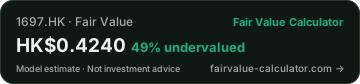
Shandong International Trust: fair value per Fair Value Calculator

Cite: Fair Value Calculator (2026). "Shandong International Trust Fair Value". https://www.fairvalue-calculator.com/stock/1697

Frequently asked questions

Is Shandong International Trust (1697) overvalued or undervalued?
As of Nov 11, 2026, our model estimates a fair value of HK$0.4240 versus a price of HK$0.2150, about +97% upside (undervalued).
What is the fair value of 1697?
Our model-based fair value for Shandong International Trust is HK$0.4240 (as of Nov 11, 2026), built from audited fundamentals. The current price: HK$0.2150.
What is the quality score of 1697?
Shandong International Trust has a Quality Score of 52/100. It measures business quality (profitability, growth, cash flow, balance-sheet strength, investment discipline, share issuance). Market factors such as price momentum and volatility do not enter the number; they are shown separately in the detail view.
What is the price target for Shandong International Trust (1697)?
Our model-based price target is the fair value of HK$0.4240 (as of Nov 11, 2026) from 2 valuation models. Cautious scenario HK$0.3180, optimistic scenario HK$0.5300. It is a calculation from audited fundamentals, not an analyst target.
What is the Shandong International Trust stock forecast for 2026?
Our models put fair value at HK$0.4240, about +97% upside versus a price of HK$0.2150 (undervalued). Cautious scenario HK$0.3180, optimistic scenario HK$0.5300. The calculation is refreshed regularly with new filings.
Does Shandong International Trust pay a dividend?
Shandong International Trust currently shows a dividend yield of 5.49% relative to its recent price (as of Nov 11, 2026).
How much is the dividend of Shandong International Trust (1697)?
Shandong International Trust has a dividend yield of 5.5%.
What is the intrinsic value of Shandong International Trust (1697)?
Intrinsic value and fair value mean the same thing: what the business is worth on its numbers, independent of the share price. For Shandong International Trust it is HK$0.4240 per share (as of Nov 11, 2026), against a price of HK$0.2150. It is the blended result of 2 valuation models in 2 families (Multiples, Asset-Based).
Is Shandong International Trust stock overvalued or undervalued in 2026?
As of Nov 11, 2026, 1697 trades below its calculated fair value: price HK$0.2150, fair value HK$0.4240, a gap of about +97% (undervalued). The calculation is refreshed with each new quarterly report, so the verdict can change during the year.
Is fair value the same as the market price of 1697?
No. The price is what the market pays today (HK$0.2150); the fair value is what the company's own numbers justify (HK$0.4240). For Shandong International Trust the two are HK$0.2090 per share apart. That gap is exactly why we show both numbers side by side.
How much is Shandong International Trust worth?
The market values Shandong International Trust at about HK$1.0B (market capitalisation, as of Nov 11, 2026). Per share that is HK$0.2150; our models calculate a fair value of HK$0.4240 per share.
What do the bullish and bearish scenarios say about 1697?
Our models span a range for Shandong International Trust: cautious scenario HK$0.3180, base HK$0.4240, optimistic HK$0.5300 per share (as of Nov 11, 2026, price HK$0.2150). The range comes from different growth and margin assumptions, not from analyst opinions.
What is the P/E ratio of 1697?
Shandong International Trust trades at a price-to-earnings ratio of 28.0 (as of Nov 11, 2026). A P/E on its own says little: it compares the price with ONE year of profit, while our fair value of HK$0.4240 is built from several models across several years.
How solid is the balance sheet of Shandong International Trust (1697)?
Balance-sheet figures for Shandong International Trust (as of Nov 11, 2026): return on equity −2.1%. They feed the Quality Score of 52/100, which measures business quality independently of the share price.
How far is 1697 from its 52-week high?
Shandong International Trust trades at HK$0.2150, about 46% below its 52-week high of HK$0.3950 and 2% above the low of HK$0.2100 (as of Nov 13, 2026). Distance from the high says nothing about value: that is what the fair value of HK$0.4240 is for.
Which stocks are comparable to Shandong International Trust?
From the same area (Financial Services) we also value Blackstone Inc, Brookfield Corporation, KKR & Co, SK Square Co, among others. Each of them has its own fair-value calculation on this site using the same models, so the comparison is like for like.
Is Shandong International Trust stock attractive at the current price?
The data as of Nov 11, 2026: price HK$0.2150, calculated fair value HK$0.4240 (+97%), Quality Score 52/100, from 2 models. Whether that fits your horizon and risk tolerance is your call. We provide the calculation, not investment advice.
How is the fair value of 1697 calculated?
We run Shandong International Trust through 2 models from 2 families: Multiples, Asset-Based. Every model gets the same audited fundamentals; the fair value of HK$0.4240 builds on their evidence-weighted average, with the spread shown as a cautious and an optimistic scenario.
Is it still worth investing in stocks now?
The global stock market currently sits 14.5% above its aggregate fair value. Shandong International Trust currently trades 49% below its own fair value, and the market average says nothing about that. An expensive market is no reason to stay out and no reason to buy everything at once: keep a broad savings plan running, buy single stocks only with money you can do without, and hold part of your money liquid while the market is high. The full picture including sectors is on is it worth investing now.
What is the share price of Shandong International Trust (1697)?
The closing price on Nov 13, 2026 was HK$0.2150. Our model-based fair value is HK$0.4240, about +97% upside (undervalued). We carry closing prices from our data provider, not a live tick.
What should I pay attention to with Shandong International Trust right now?
The price is below even our cautious bear case (HK$0.3180). The market is more pessimistic than our downside scenario. The large gap to fair value rests on thin data (low evidence): fewer applicable models and a shorter history. Read it with extra caution. Solid quality (52/100) at a price below fair value, the discount is the argument here, not the business quality. For a financial, book-value and earnings-based methods matter more than a cash-flow DCF, which fits banks and insurers poorly.
Where does the earnings growth of Shandong International Trust (1697) come from?
Earnings per share at Shandong International Trust fell 20.8 % a year from 2014 to 2025. Broken into its drivers: revenue per share −8.1 %, EBIT margin −4.4 %, tax rate −2.6 %, residual (interest, one-offs) −7.4 %. The four rates multiply to the earnings growth rate, they do not add up. Start and end are three-year averages so a single exceptional year does not distort the result.

Key figures of Shandong International Trust

How large is the market capitalisation of Shandong International Trust (1697)?
The market capitalisation of Shandong International Trust is HK$1.0B (≈ $128M). The stock-market value of the whole company: share price times number of shares. It is what the market asks for the entire business today.
What is the P/S ratio of Shandong International Trust (1697)?
The price-to-sales ratio of Shandong International Trust is 2.31 (P/E × margin). Price to sales: market value relative to yearly revenue. Useful when profit is thin or distorted.
What is the dividend yield of Shandong International Trust (1697)?
The dividend yield of Shandong International Trust is 5.5%. Yearly dividend relative to the share price. 3% pays 3 per 100 invested. Below: how much of profit is used for it.
What is the net margin of Shandong International Trust (1697)?
The net margin of Shandong International Trust is 8.3% (fiscal year 2025). How much of every unit of revenue ends up as profit. 10% means 10 cents of profit per dollar of sales.
What is the return on equity of Shandong International Trust (1697)?
The return on equity (ROE) of Shandong International Trust is −2.1% (last twelve months). Profit relative to shareholders' equity, how efficiently the company works with its owners' money.
What is the EBIT return on assets of Shandong International Trust (1697)?
On an EBIT basis the return on assets of Shandong International Trust is 2.3% (avg 5y). Operating profit (EBIT) relative to everything the company owns, as a multi-year average. It describes the business model rather than one good or bad year.
What is the operating margin of Shandong International Trust (1697)?
The operating margin of Shandong International Trust is 187% (last twelve months). Profit from the core business (before interest and taxes) relative to revenue.
How much revenue does Shandong International Trust (1697) generate?
Shandong International Trust generates revenue of −HK$44.9M (last twelve months). Revenue of the last twelve months (TTM), the most recent full year, not the calendar year.
How fast is revenue growing at Shandong International Trust (1697)?
Revenue at Shandong International Trust is down 79.5% versus a year earlier (3y avg −8.6%). How much revenue grew versus a year earlier (YoY). The 3-year average next to it puts the single year in context.
How fast are earnings growing at Shandong International Trust (1697)?
Earnings per share at Shandong International Trust are down 1.8% versus a year earlier. How much earnings per share grew versus a year earlier.
How much free cash flow does Shandong International Trust (1697) generate?
The free cash flow of Shandong International Trust is −242M CNY (fiscal year 2025). The cash truly left after running and investing in the business, this is what pays dividends and buybacks.
How much net cash does Shandong International Trust (1697) hold?
Shandong International Trust holds more cash than debt, 157M CNY net (fiscal year 2025). The company holds more cash than debt, a safety cushion.
Free · no account needed

Watch Shandong International Trust in the live analysis

One click puts Shandong International Trust on your watchlist: fair value and trend at a glance, plus comparison, the diversification check and the 27,000+ stock screener.

Watch for free →

Zero risk: nothing is ever charged. Your watchlist is yours, with or without an account.