EN DE
Watch Cascades Inc. for free: we tell you when fair value or trend changes.
Data-driven stock valuation

Cascades Inc. (CAS) fair value: what the stock is really worth

As of Nov 12, 2026: fair value (intrinsic value) of Cascades Inc. stock C$12.38, price C$15.93, that is 22.3% below the price, quality 57 out of 100. Rating: overvalued. Calculated from audited financials with 24 of our 26 valuation models and 37 quality factors, updated daily.

  1. Keep an eye on it?Free in your watchlist: 5 stocks without an account, 10 with one Yes, for free

Consumer Cyclical CA · ISIN CA1469001053

CI Cascades Inc. logo Broad data Nov 10, 2026

Cascades Inc.

CAS · TO

Expensive (fair value 22% below the price), but solid company and rising price: meets 2 of 3 rules.

Get notified free when this changes
Rising price (uptrend) 
Generates free cash flow 
3.0% dividend yield · Well covered
Ranks above peers (9/15) 
Broad data 
Quality 57/100 
Thin margins · 2.6% net margin (TTM) 
Moderate debt 
Changed on Nov 5: C$15.26 → C$12.38 
Fair value C$12.38 · Overvalued 
Weak Growth (revenue 5y −1.5 %/yr in CAD) 
Narrow moat 37/100 · thin data
Watch Cascades Inc. for free: we tell you when fair value or trend changes. Watch for free

What runs behind every stock

69 individual criteria per stock, every one traceable See the method →

Price vs Fair Value

C$18.57 C$6.59 Fair Value C$12.38 Aug 2021 Nov 2026

White line = price, green steps = our fair value per fiscal year. As of Nov 10, 2026.

How to read this chart

60‑month range C$6.59 – C$18.57 · fair‑value band C$8.73 – C$15.47 · the C$15.93 price screens above the C$12.38 fair value. Green steps = our fair value per fiscal year (point-in-time, no hindsight). 1 fiscal year is left out: there the valuation rested on only a fraction of the usual models. As of Nov 10, 2026.

Follow Cascades in your weekly email

Every Wednesday you see whether Cascades is on track or worth a review, plus price against fair value. Free, up to 3 stocks.

We send you a confirmation link. Unsubscribe with one click.

Which stocks are undervalued right now? Check free Discover now →

Company profile

Cascades Inc., together with its subsidiaries, produces, converts, and markets packaging and tissue products in Canada and the United States. The company operates through two segments, Packaging Products, and Tissue Papers.

Show moreShow less

It offers food packaging solutions, such as trays and accessories, produce baskets, boxes and trays, egg packaging, bulk bins, and cup carriers; protective packaging, including regular boxes, protection and handling, die-cut boxes, shipping trays, and large format boxes; e-commerce packaging solutions comprising adjustable cardboard boxes, compact mailer boxes, die-cut mailer boxes, and quick assembly boxes; and retail and customer packaging, die-cut mailer boxes, and POS and displays.

The company also provides hygiene and tissue paper products; and fiber based materials, which includes tissue paper jumbo rolls, containerboard, specialty papers, technological barrier solutions, and uncoated recycled paperboard.

In addition, it offers transportation, specialized warehousing, and inventory management services; and recycling solutions consisting of recycling services, brokering and trading materials, secure shredding, recycling equipment, industrial and commercial, retailers and grocers, municipal sector, and graphic design and printing.

The company provides its products and services under the Cascades Fresh, Cascades Protect, Cascades IMGN, Cascades Fluff & Tuff, and Cascades PRO brand names. Cascades Inc. was incorporated in 1964 and is headquartered in Kingsey Falls, Canada.

Stock analysis

Cascades Inc. (CAS) currently trades at C$15.93, while our model-based Fair Value estimate is C$12.38, 22% below the price, so the stock looks overvalued today.

Show more

Valuation

Bull case: the Growth DCF group reads highest at a median of C$18.92 per share, and 10 of the 24 models we run sit above the C$15.93 price.

Bear case: the Dividend Discount group reads lowest at C$4.06, and 14 of the 24 models stay below the price. Data coverage for this calculation is high.

Scenario range: C$8.73 (bear) to C$15.47 (bull), the price of C$15.93 sits above it. Bear and bull are the same models on cautious and optimistic assumptions, a range, not a price target.

Quality & growth

The Quality Score stands at 57/100 (solid quality), in the Consumer Cyclical sector.

Weak Growth: Revenue growth is weak: less than 2 % a year.

Cascades Inc. reported revenue of C$4.8B in FY2025 versus C$4.0B in FY2021, a compound +4.8%/yr. Reported net income was C$70.0M in FY2025.

Key figures

Market cap C$1.6B (≈ $1.1B) Small · P/E ratio 12.7 · P/S ratio 0.45 · EPS (TTM) C$1.25 · Dividend yield 3.0% · Net margin 2.6% · Return on equity 8.5% · Return on assets (EBIT) 3.1% (5-year average).

Competitive moat

Our AI-assisted moat analysis scores the competitive advantage at 37 out of 100 (low confidence).

What moves the price

The share trades about 14% below its 52-week high and 57% above its 52-week low, currently above its 200-day average.

For context, the median of 10 Consumer Cyclical peers we cover trades at −19% fair-value upside, at −22%, CAS screens richer than that median.

Fair Value models

Bear C$8.73 Fair Value C$12.38 Bull C$15.47
Price C$15.93 · Downside -22.3%
Model ⓘEach model values the company its own way (discounted cash flow, earnings, assets, dividends). The fair value above starts from their evidence-weighted blend, not from a single model. In cyclical trough or peak years, after dilution or a stock split it is adjusted afterwards, so it can sit above or below the models. Based on fiscal year 2025 figures (about 10 months old). Earnings retained since then (C$0.6687 per share) are deliberately not added. Bear ⓘBear = the cautious scenario: the same model computed with conservative anchors (lower growth, margins and valuation multiples). Together with Bull it frames a plausible valuation range, not a price target.BaseBull ⓘBull = the optimistic scenario: the same model computed with favourable anchors (higher growth, margins and valuation multiples). Together with Bear it frames a plausible valuation range, not a price target. If a model's bull case is above four times its base value, the table shows that limit with a > sign (like the overall Bull above): beyond it no assumption holds. Coverage ⓘCoverage = how well-backed THIS model's estimate is for this stock (0–100): how complete and reliable its input data are, and how well the model fits the company. The final Fair Value is an evidence-weighted blend, so better-evidenced models count more. Green ≥70, amber 50–69, grey below 50.
Best data coverage
FCF DCF C$11.72 C$19.46 C$31.02 78
Growth DCF C$12.37 C$19.69 C$29.99 76
Residual Income C$12.25 C$12.09 C$12.38 76
All 24 models by family
DCF Models
FCF DCF C$11.72 C$19.46 C$31.02 78
Owner Earnings C$10.16 C$17.39 C$28.19 74
5Y Revenue Exit C$8.88 C$17.72 C$29.36 69
5Y EBITDA Exit C$14.47 C$27.38 C$42.83 72
5Y P/E Exit C$2.10 C$6.02 C$10.20 66
10Y Revenue Exit C$9.34 C$17.02 C$25.91 64
10Y EBITDA Exit C$13.13 C$23.12 C$34.71 66
10Y P/E Exit C$5.87 C$9.64 C$13.40 63
Earnings-Based
Graham-Dodd C$4.66 C$8.91 C$11.11 66
EPV C$5.31 C$7.86 C$10.02 72
Dividend Discount
Gordon GGM C$3.04 C$4.04 C$5.00 69
DDM Multi-Stage C$3.04 C$4.07 C$5.20 67
Multiples
P/E Multiple C$8.73 C$11.65 C$14.56 63
P/S Multiple C$8.73 C$11.65 C$14.56 57
P/B Multiple C$9.28 C$12.38 C$15.47 55
EV/EBIT C$9.55 C$17.38 C$25.22 62
EV/EBITDA C$18.68 C$29.57 C$40.45 65
EV/Revenue C$6.41 C$15.14 C$23.88 50
Asset-Based
NCAV (Graham) C$5.87 C$7.87 C$11.74 53
Growth DCF
Growth DCF C$12.37 C$19.69 C$29.99 76
Rev-Margin DCF C$8.88 C$18.14 C$28.74 69
Economic Profit
Residual Income C$12.25 C$12.09 C$12.38 76
ROIC Compounder C$5.31 C$7.86 C$10.02 71
Growth Earnings
Growth-Adj P/E C$6.33 C$9.04 C$11.75 67

Open the full fair value analysis →

Quality Score breakdown

Overall quality 57/100

It rates the business: profits, how they develop, real cash, balance sheet, investing and share count.

Profitability 34
How much profit the company makes from its sales and capital
Quality Growth 55
Are margins and returns getting better?
Cashflow 53
Do the profits arrive as real cash?
Financial strength 33
Debt, balance sheet and risk of trouble
Investment 98
Does it invest with discipline instead of growing at any price?
Low Volatility 73
How calm the share price moves, does not count
Price momentum 73
Price momentum of the last 3 to 12 months, does not count
Near the 52-week high 69
Distance to the 52-week high, does not count
New shares 79
Buys back shares or issues new ones?

Open the full quality analysis →

Revenue & earnings trend

Growth Quality ⓘGrowth is valuable only when reinvestment earns attractive returns (Aswath Damodaran): sustainable growth depends on return on capital, reinvestment and efficiency. Basis: total company revenue over the periods shown on the cards (3Y/5Y/all years), not per share, so a merger can show up as a growth jump; per-share earnings growth is in the value-creation card. 40/100
Revenue growth is weak: less than 2 % a year.
Revenue growth 1 year
+1.6%
Revenue growth 3 years ⓘMeasures the company's TOTAL revenue from reported annual statements: compound average growth per year (CAGR) from the fiscal year 3, 5 or N years back to the most recent comparable fiscal year. Not per share: buybacks do not change this number, and a merger can appear as a growth jump. Per-share growth (which does include buybacks) is in the value-creation card.
+2.3%
Revenue growth 5 years ⓘMeasures the company's TOTAL revenue from reported annual statements: compound average growth per year (CAGR) from the fiscal year 3, 5 or N years back to the most recent comparable fiscal year. Not per share: buybacks do not change this number, and a merger can appear as a growth jump. Per-share growth (which does include buybacks) is in the value-creation card.
−1.5%
Start year 2020 (pandemic). Over 10 years: +2.1% a year
Revenue growth 29 years ⓘMeasures the company's TOTAL revenue from reported annual statements: compound average growth per year (CAGR) from the fiscal year 3, 5 or N years back to the most recent comparable fiscal year. Not per share: buybacks do not change this number, and a merger can appear as a growth jump. Per-share growth (which does include buybacks) is in the value-creation card.
+2.9%
What shareholders gained per year (last 5 years) ⓘWhat the business itself delivers per year: earnings growth per share plus the dividend yield. This is what you get IF the market keeps valuing the stock the same way: it contains no assumption about the market changing its mind. Computed per share, so buybacks count and a merger does not pass as growth. For a company that pays no dividend it is pure earnings growth per share. Period: earnings growth per share as CAGR over the last 5 reported fiscal years (annual statements), plus the current dividend yield. The start value is the median of the three years around the start, so a single crisis year (a pandemic or a write-down) does not distort the rate.
−11.8%
Earnings growth per share plus dividend.
Earnings per share, growth per year−14.8%
Dividend (yield on the price)3.0%
Pace: 5 vs 10 years ⓘTwo data points, not a trend model: earnings growth per share over the last 5 fiscal years against the last 10. Labelled "steady" when both rates are within 3 percentage points of each other, otherwise picking up or flattening. Shown only when ten years of history exist.−14.8% vs −6.8%, slowing
Profit margin 2020 to 2025 ⓘOperating margin then vs now, from reported annual statements. A falling margin after a boom year is the classic peak-earnings signal: the growth rate then leans on an inflated base.7% → 6%
Pace: the 5-year rate starts in 2020 (pandemic)

Growth Forecast

Price in line with expectations
The price assumes more growth than the company has delivered so far and about what analysts expect.
What the price assumes ⓘThis turns our valuation around: instead of asking what the share is worth, it asks what growth the current price requires. It uses the cash the company keeps after all spending (free cash flow), the same discount rate as our models, five years of growth, then slowing evenly to 2 % a year by year ten. Compared with the analysts' sales forecasts extended to the same five years (at least three analysts, for context only, it does not enter the Fair Value): within 3 percentage points counts as "in line" (amber), below that little optimism (green), above that a lot of optimism (red).
+4.5%
Yearly growth needed for the next five years to justify today's price.
What forecasts expect ⓘAnalysts publish sales forecasts for the next two fiscal years. For the years after that, growth slows evenly to 2 % a year by year ten (2 % is the long-run rate our models use). Projected years are marked as such.
+6.4%
Yearly sales growth analysts expect, extended to five years.
After inflation (Canada: IMF forecast 2.1% a year to 2030, 2.6% from 2016 to 2025) that is about +2.4% a year for the price and +4.2% for the forecasts.
Forecast 2026 (sales)+2.0%
Forecast 2027 (sales)+8.8%
Projected 2028 (sales)+7.9%
Projected 2029 (sales)+7.1%
Projected 2030 (sales)+6.2%

CAS screens overvalued: fair value 22% below the price. Compare with Smurfit Westrock Plc, →

Compare Cascades Inc. with another stock

Price, fair value, quality and upside side by side.

Free, no sign-up

Peer GroupⓘHow this stock ranks against its industry: the green marker is this stock, the band is the typical 25–75% peer range, and the tick is the median.Packaging & Containers · 270 stocks

Beats the industry median on 9/15 measures
Overall it ranks above its industry peers.
Valuation
Quality Score 57 · Above median
Fair Value upside −22.3% · Below median
Profitability
Return on equity (12 months) 8.5% · Above median
Return on assets 2.0% · Below median
Net margin (12 months) 3.5% · Below median
Operating margin (12 months) 7.0% · Above median
Growth and dividend
Revenue growth (quarter YoY) 2.3% · Below median
Dividend yield (12 months) 3.0% · Above median
Balance sheet
Debt / equity 0.97× · Highest 25%

Valuation Multiplesvs Packaging & Containers median · lower = cheaper

P/E (12 months) 12.7× · Cheaper than median
P/B 0.94× · Cheaper than median
P/S (12 months) 0.45× · Cheaper than median
Price / free cash flow (fiscal year) 9.5× · Cheaper than median
EV/EBITDA 7.6× · Pricier than median
PEG 0.47× · Cheapest 25%

Strength profile in five axes (Snowflake)

VALUEFUTUREPASTHEALTHDIVIDEND
This stock
VALUEFUTUREPASTHEALTHDIVIDEND
Sector peers
VALUE (fair-value potential)4 · sector 21
FUTURE (revenue growth)12 · sector 44
PAST (return on equity)34 · sector 26
HEALTH (low debt)51 · sector 92
DIVIDEND (yield)60 · sector 47

Context: sector, industry, market

Values & ESG

Does this company touch areas you may want to avoid? The classification is inferred from sector and industry.

None of the checked exposures detected

Similar stocks

10 more Packaging & Containers stocks, each showing price versus our Fair Value estimate.

Stock Price Fair Value vs Fair Value Compare
Smurfit Westrock Plc, SW $43.18 $44.16 +2% vs CAS
Crown Holdings CCK $120.48 $121.85 +1% vs CAS
Stora Enso Oyj STEAV €9.72 €9.67 −1% vs CAS
International Paper Company IP $33.94 $31.86 −6% vs CAS
Reynolds Consumer Products Inc REYN $24.50 $19.83 −19% vs CAS
Ball Corporation BALL $64.91 $48.92 −25% vs CAS
Amcor plc AMCR $43.80 $31.20 −29% vs CAS
Avery Dennison Corporation AVY $186.96 $125.58 −33% vs CAS
SIG Group SIGN CHF 15.53 CHF 9.12 −41% vs CAS
Packaging Corporation PKG $250.58 $130.52 −48% vs CAS

Explore undervalued stocks

More undervalued Consumer Cyclical stocks →

Try a ready-made strategy

Pick a strategy and jump into the live analysis with that exact screen applied.

🥇 Backtested Best 🏆 Big Names 💎 Quality on Sale 🚀 Profitable Growth 🧊 Quality Compounders 💵 Dividend Stars 📈 Strong Momentum 📉 Fallen Angels ⚖️ Deeply Undervalued 🔍 Small-Cap Gems 🏰 Moat at a Fair Price 💼 Insider Buying 🎩 Buffett-Style Quality 📚 Peter Lynch GARP 🧮 Greenblatt Magic Formula 🛡️ Graham Defensive

Discover tools

For bloggers & editors: embed code + live data

For bloggers, editors and developers: paste this into your site or blog (a “Custom HTML” block in WordPress), it shows the current fair value and links back here. Free, plain HTML, and welcome. Full data streams (CSV/JSON) at /developers.
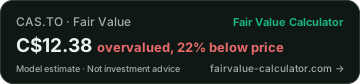
Cascades Inc.: fair value per Fair Value Calculator

Cite: Fair Value Calculator (2026). "Cascades Inc. Fair Value". https://www.fairvalue-calculator.com/stock/CAS

Frequently asked questions

Is Cascades Inc. (CAS) overvalued or undervalued?
As of Nov 10, 2026, our model estimates a fair value of C$12.38 versus a price of C$15.93, about 22% lower (overvalued).
What is the fair value of CAS?
Our model-based fair value for Cascades Inc. is C$12.38 (as of Nov 10, 2026), built from audited fundamentals. The current price: C$15.93.
What is the quality score of CAS?
Cascades Inc. has a Quality Score of 57/100. It measures business quality (profitability, growth, cash flow, balance-sheet strength, investment discipline, share issuance). Market factors such as price momentum and volatility do not enter the number; they are shown separately in the detail view.
What is the price target for Cascades Inc. (CAS)?
Our model-based price target is the fair value of C$12.38 (as of Nov 10, 2026) from 24 valuation models. Cautious scenario C$8.73, optimistic scenario C$15.47. It is a calculation from audited fundamentals, not an analyst target.
What is the Cascades Inc. stock forecast for 2026?
Our models put fair value at C$12.38, about 22% lower versus a price of C$15.93 (overvalued). Cautious scenario C$8.73, optimistic scenario C$15.47. The calculation is refreshed regularly with new filings.
What is the revenue of Cascades Inc. (CAS)?
Cascades Inc. reported trailing-twelve-month revenue of about C$4.8B (latest available figure, as of Nov 10, 2026).
Does Cascades Inc. pay a dividend?
Cascades Inc. currently shows a dividend yield of 3.01% relative to its recent price (as of Nov 10, 2026).
How much is the dividend of Cascades Inc. (CAS) and when is the ex-dividend date?
Cascades Inc. pays a dividend of C$0.48 per share a year, a dividend yield of 3.0%. The next ex-dividend date is Nov 19, 2026. A dividend has been paid every year since at least 1996. The payout ratio is 38.4% of earnings. Free cash flow covers the dividend 4.63 times. Our assessment: Well covered. A low payout and the dividend is fully funded by free cash flow, a comfortable, sustainable dividend.
What growth is priced into Cascades Inc. (CAS)?
For today's price to be fair in a discounted-cash-flow model, Cascades Inc. would have to grow free cash flow by +4.5 % per year for five years (discount rate 10.2 %, then slowing evenly to 2 % perpetual growth by year ten). Over the last 5 years revenue grew -1.5 % per year. As of Nov 10, 2026.
What discount rate (WACC) does the fair value of CAS use?
Our models discount Cascades Inc. at 10.2 %: a base by market capitalisation (small), damped by beta 0.70, country premium for Canada. The same rate applies in all 26 models.
What is a reverse DCF?
A reverse DCF turns the usual calculation around. Instead of deriving a value from assumptions, it takes today's price as given and asks: what free-cash-flow growth would a company have to deliver for exactly this price to be fair? The result is not a forecast but the expectation already priced in. For Cascades Inc. that is +4.5 % per year for five years, then slowing evenly to 2 % by year ten, using the same discount rate (10.2 %) and the same formula as our fair value.
How much growth has Cascades Inc. (CAS) delivered so far?
Over the past 5 years revenue at Cascades Inc. grew -1.5 % a year. The price currently implies free-cash-flow growth of +4.5 % per year. Comparing the two shows how much confidence is in the price: if it demands more than has been delivered, the business has to accelerate for the maths to work.
How fast is the sector of Cascades Inc. (CAS) growing?
The median revenue growth in the sector is +8.7 % a year. That is the yardstick for the growth priced into Cascades Inc. (+4.5 % per year): it shows whether the expectation is within the usual range or beyond it.
What is the free cash flow yield of Cascades Inc. (CAS)?
The free-cash-flow yield on the price is 14.02 %: that much free cash flow Cascades Inc. produces per unit of market value. When it exceeds the discount rate of our models (10.2 %), the business already earns more than its cost of capital demands, and the price needs little additional growth.
What is the intrinsic value of Cascades Inc. (CAS)?
Intrinsic value and fair value mean the same thing: what the business is worth on its numbers, independent of the share price. For Cascades Inc. it is C$12.38 per share (as of Nov 10, 2026), against a price of C$15.93. It is the blended result of 24 valuation models in 8 families (DCF Models, Earnings-Based, Dividend Discount, Multiples, Asset-Based, Growth DCF, Economic Profit, Growth Earnings).
Is Cascades Inc. stock overvalued or undervalued in 2026?
As of Nov 10, 2026, CAS trades above its calculated fair value: price C$15.93, fair value C$12.38, a gap of about −22% (overvalued). The calculation is refreshed with each new quarterly report, so the verdict can change during the year.
Is fair value the same as the market price of CAS?
No. The price is what the market pays today (C$15.93); the fair value is what the company's own numbers justify (C$12.38). For Cascades Inc. the two are C$3.55 per share apart. That gap is exactly why we show both numbers side by side.
How much is Cascades Inc. worth?
The market values Cascades Inc. at about C$1.6B (market capitalisation, as of Nov 10, 2026). Per share that is C$15.93; our models calculate a fair value of C$12.38 per share.
What do the bullish and bearish scenarios say about CAS?
Our models span a range for Cascades Inc.: cautious scenario C$8.73, base C$12.38, optimistic C$15.47 per share (as of Nov 10, 2026, price C$15.93). The range comes from different growth and margin assumptions, not from analyst opinions.
What is the P/E ratio of CAS?
Cascades Inc. trades at a price-to-earnings ratio of 12.7 (as of Nov 10, 2026). A P/E on its own says little: it compares the price with ONE year of profit, while our fair value of C$12.38 is built from several models across several years. Median P/E at fiscal year-end, 6 fiscal years (2016 to 2025), reported earnings: 9.9. Other multiples: PEG 0.5, P/B 0.9, P/S 0.4, EV/EBITDA 7.6.
What is the PEG ratio of CAS?
The PEG ratio of Cascades Inc. is 0.47 (P/E divided by earnings growth, as of Nov 10, 2026). That is below 1, so growth is priced more cheaply than the earnings multiple alone suggests.
How solid is the balance sheet of Cascades Inc. (CAS)?
Balance-sheet figures for Cascades Inc. (as of Nov 10, 2026): return on equity 8.5%, debt of 0.97 per unit of equity. They feed the Quality Score of 57/100, which measures business quality independently of the share price.
How far is CAS from its 52-week high?
Cascades Inc. trades at C$15.93, about 14% below its 52-week high of C$18.57 and 57% above the low of C$10.12 (as of Nov 12, 2026). Distance from the high says nothing about value: that is what the fair value of C$12.38 is for.
Which stocks are comparable to Cascades Inc.?
From the same area (Consumer Cyclical) we also value Smurfit Westrock Plc,, Packaging Corporation, Amcor plc, International Paper Company, among others. Each of them has its own fair-value calculation on this site using the same models, so the comparison is like for like.
Is Cascades Inc. stock attractive at the current price?
The data as of Nov 10, 2026: price C$15.93, calculated fair value C$12.38 (−22%), Quality Score 57/100, from 24 models. Whether that fits your horizon and risk tolerance is your call. We provide the calculation, not investment advice.
How is the fair value of CAS calculated?
We run Cascades Inc. through 24 models from 8 families: DCF Models, Earnings-Based, Dividend Discount, Multiples, Asset-Based, Growth DCF, Economic Profit, Growth Earnings. Every model gets the same audited fundamentals; the fair value of C$12.38 builds on their evidence-weighted average, with the spread shown as a cautious and an optimistic scenario.
Is it still worth investing in stocks now?
The global stock market currently sits 14.3% above its aggregate fair value. Cascades Inc. itself currently trades above fair value. An expensive market is no reason to stay out and no reason to buy everything at once: keep a broad savings plan running, buy single stocks only with money you can do without, and hold part of your money liquid while the market is high. The full picture including sectors is on is it worth investing now.
What is the share price of Cascades Inc. (CAS)?
The closing price on Nov 12, 2026 was C$15.93. Our model-based fair value is C$12.38, about 22% lower (overvalued). We carry closing prices from our data provider, not a live tick.
What should I pay attention to with Cascades Inc. right now?
The price sits above even our optimistic bull case (C$15.47). The favourable scenario is already priced in. Solid but not exceptional quality (57/100) and above fair value, neither a clear bargain nor a standout compounder.

Key figures of Cascades Inc.

How large is the market capitalisation of Cascades Inc. (CAS)?
The market capitalisation of Cascades Inc. is C$1.6B (≈ $1.1B). The stock-market value of the whole company: share price times number of shares. It is what the market asks for the entire business today.
What is the P/S ratio of Cascades Inc. (CAS)?
The price-to-sales ratio of Cascades Inc. is 0.45 (last twelve months). Price to sales: market value relative to yearly revenue. Useful when profit is thin or distorted.
What are the earnings per share of Cascades Inc. (CAS)?
Earnings per share at Cascades Inc. are C$1.25 (price ÷ EPS = P/E 12.7). Earnings per share over the last twelve months: total profit spread across every single share.
What is the dividend yield of Cascades Inc. (CAS)?
The dividend yield of Cascades Inc. is 3.0% (payout 38.4%). Yearly dividend relative to the share price. 3% pays 3 per 100 invested. Below: how much of profit is used for it.
What is the net margin of Cascades Inc. (CAS)?
The net margin of Cascades Inc. is 2.6% (last twelve months). How much of every unit of revenue ends up as profit. 10% means 10 cents of profit per dollar of sales.
What is the return on equity of Cascades Inc. (CAS)?
The return on equity (ROE) of Cascades Inc. is 8.5% (last twelve months). Profit relative to shareholders' equity, how efficiently the company works with its owners' money.
What is the EBIT return on assets of Cascades Inc. (CAS)?
On an EBIT basis the return on assets of Cascades Inc. is 3.1% (avg 5y). Operating profit (EBIT) relative to everything the company owns, as a multi-year average. It describes the business model rather than one good or bad year.
What is the operating margin of Cascades Inc. (CAS)?
The operating margin of Cascades Inc. is 7.0% (last twelve months). Profit from the core business (before interest and taxes) relative to revenue.
How fast is revenue growing at Cascades Inc. (CAS)?
Revenue at Cascades Inc. is growing +2.3% versus a year earlier (3y avg +2.3%). How much revenue grew versus a year earlier (YoY). The 3-year average next to it puts the single year in context.
How fast are earnings growing at Cascades Inc. (CAS)?
Earnings per share at Cascades Inc. are growing +3.1% versus a year earlier. How much earnings per share grew versus a year earlier.
How much net debt does Cascades Inc. (CAS) carry?
The net debt of Cascades Inc. is C$1.9B (fiscal year 2025, ≈ 8.4 yrs of FCF). Debt minus cash on hand. The note shows how many years of free cash flow could in theory pay it off.
Free · no account needed

Watch Cascades Inc. in the live analysis

One click puts Cascades Inc. on your watchlist: fair value and trend at a glance, plus comparison, the diversification check and the 27,000+ stock screener.

Watch for free →

Zero risk: nothing is ever charged. Your watchlist is yours, with or without an account.